The Sakura Wars series has a long history in Japan, mixing Tactical RPG play with at-length storytelling and even some dating sim elements. That might sound like a ridiculous combination, but when combined with top-notch production values it seems to work out just fine; certainly well enough that the series was a merchandising juggernaut for about a decade and even had its own theme cafe at one point. What kind of game play could spawn this success, and what can players here in the west look forward to?
Sakura Wars: So Long My Love puts you in the role of Shinjiro Taiga, a nineteen year-old who describes himself as a samurai in training. He initially believes he’s being recruited to the Japanese division of an elite anti-demon force, only to instead be assigned to lead the American branch in New York City, known as the "New York Combat Revue" due to most of its roster also being classical theater performers. Thus the team splits its time between theater productions, their daily lives, and fending off demon invasions by piloting giant robots known as STARs. While every character falls under your command once combat starts, you only control Shinjiro in many of the other parts of this game.
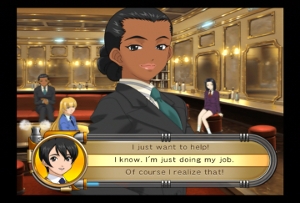
While commanding a team of STARs may be the main attraction, you actually spend much of your time exploring the lives and activities of various characters. Sometimes this serves to move the plot forward like it does in most RPGs, but the choices and actions you have Shinjiro make will help or hinder others. Doing well during these segments is important since much of Shinjiro’s time is spent with the pilots under his command, and they perform better in combat if he can help them and make them happy. This is also where the game’s dating sim elements come in to play, since the majority of the New York Combat Revue’s roster is female. It’s silly, but it’s a series staple and these games were originally meant for a Japanese audience.
What makes this unusual is the game’s setting and story tone. Sakura Wars takes place in a steampunk-style 1920s Earth, which means the fashion and design are very retro but their technology is well ahead of the real world’s. This is used to very dramatic effect, as the New York Combat Revue do not simply march to the site of any demon incursion. They prefer to get around New York City in a massive airship housed beneath their theater, which they load onto a ship-scale ballista in order to launch. This is usually followed by doing an aerial drop right into the enemy formation and striking poses; it lends itself to an odd mix of ’epic’ exploits and 80s/early 90s anime campiness that works surprisingly well.
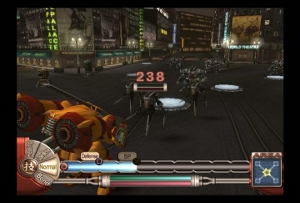
Once the team is on the field, you get to the Tactical RPG segment and are able to control the STARs. Short for "Super Telekinetic Assault Robot", these machines are somewhere around 10-20 meters tall; somewhat similar in size as Mechs from BattleTech and Valkyries from Macross/Robotech, or a little smaller than most things from Gundam. STARs are fast and flashy, able to engage in swordfights on foot or change into a jet-like flight mode to fight distant enemies using missiles, though they’re also able to execute various anime-style ’super attacks.’ Despite this, no single STAR is invulnerable and you must use teamwork in order for them to win.
Combat is done in a turn-based style, with each character having a mobility gauge that reflects how far they can move, how many attacks they can make, and so on. You usually won’t be able to do everything you want in a single turn, so prioritizing is important. While the controls and concepts are simple, you’re given so many different options that you will have to put some thought into what to do. It might be fine to charge the enemy, or perhaps you’re better served by taking a defensive position and counter-attacking. It’s also important to keep your team repaired during the fight and position them well so they can use their dramatic super attacks, especially against the massive and powerful bosses you’ll encounter. Interestingly, you can have fights happening on several maps at once and forcing you to split your team; some of them may be needed to stay in the sky and engage the main enemy line, while a few others slip beneath the boss on foot to deliver a crippling blow to its weak point. This keeps things simple while still offering enough variety to make fights enjoyable, and well worth the time you spent in the storyline segments beforehand.
 It should be noted that Sakura Wars is a very different kind of game from what we might expect in America. It was made by a Japanese developer, for a Japanese audience, and NIS America is taking a bold step in translating it for a western market. Yet this early build showed a lot of potential, so hopefully the final product will live up to the expectations set by what was able to be seen so far. GDN will have a full review upon the game’s release, of course!
As for a release date, NISA’s news site has the full details, but here�s a quick summary: They�re aiming for a March 23, 2010 release on PS2 and Wii. The Wii version will be $30, while the PS2 version will be a collector�s edition at $40 and includes a second game disc with the original Japanese voices, an art book, and a poster.


